
Clinical Pattern Recognition
Made Simple
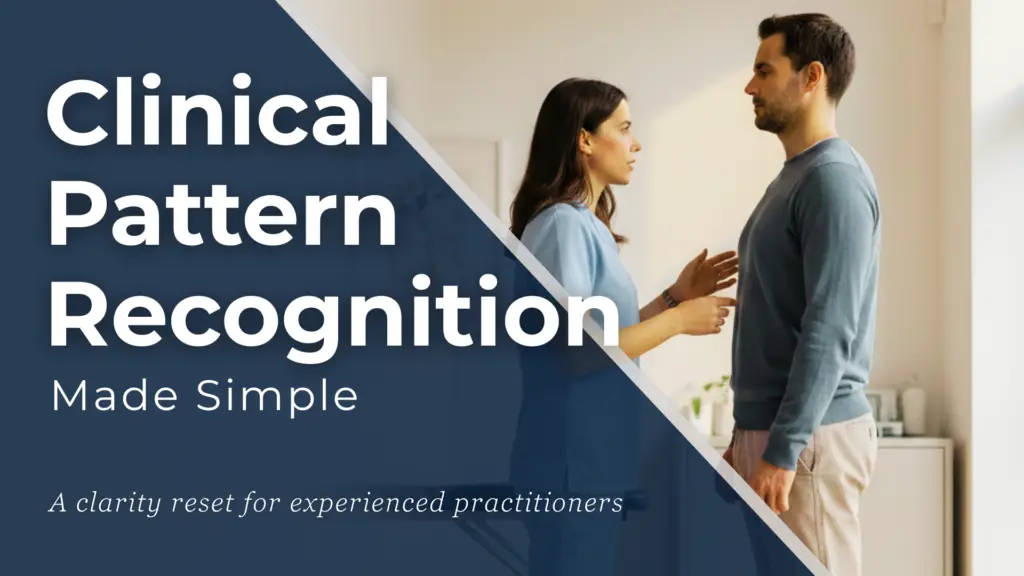
Restore clarity in complex assessments without adding another complicated system.
A practical framework for recognising primary drivers, separating them from compensations, and organising what you observe in clinic.
- A simple lens to spot primary drivers
- A repeatable reasoning loop you can use in real sessions
- Designed for practitioners across modalities
$127, instant access, self-paced
When everything looks relevant, nothing feels clear
Over time, experience expands perception.
You begin to see more asymmetries, more compensations, and more possible explanations.
But when every finding feels equally important, clinical reasoning becomes crowded.
This course introduces a simple pattern-based lens that helps you:
- Identify primary drivers
- Distinguish driver vs compensation
- Reduce assessment noise
- Move toward clearer decisions
This course helps you reduce assessment noise so you can decide what matters first, and act with confidence.
Cleaner assessments start with recognising what actually organises the pattern
Clinical Pattern Recognition Made Simple introduces a simple pattern-recognition lens that helps practitioners organise what they observe during assessment.
Instead of chasing every asymmetry or compensation, the framework helps you recognise which elements are likely organising the presentation and which are adapting around them.
The goal is not to add another complex system.
It is to help your assessments feel cleaner and easier to interpret, so you can move forward without second-guessing every observation.
What you’ll be able to do after this course
- Recognise three high-yield drivers that frequently organise posture and movement presentations.
- Separate primary influence from secondary adaptation (driver vs compensation)
- Use a simple reasoning loop during assessment to organise what you see
- Decide what deserves attention first, without second-guessing every detail
- Apply your existing hands-on or coaching skills with clearer direction
This is a clarity and organisation course. It’s not designed to replace your modality or re-train your entire approach.
What’s inside (5 lessons, designed to be practical)
Structured. Focused. Designed for immediate clinical application.
Lesson 1: The Pattern Lens
Introduces the pattern-based framework used throughout the course.
Explains the driver–compensation distinction and the reasoning structure.
Lesson 2: Driver 1 - The Pelvis
Explores pelvic positioning and its role in posture and movement presentations.
Covers common asymmetries and their influence on assessment findings.
Lesson 3: Driver 2 - The Shoulder
Examines shoulder positioning within the pattern framework.
Distinguishes primary influence from secondary adaptation.
Lesson 4: Driver 3 - Pelvic Orientation and Functional Leg Length
Outlines how functional leg length differences appear within movement patterns.
Clarifies structural and positional considerations.
Lesson 5: Pulling It Together
Demonstrates how the framework is applied across real assessment scenarios.
Focuses on prioritisation and clinical organisation.
Includes downloadable practitioner tools to support implementation, including worksheets, reference prompts, and practical notes.
Who this course is for
Practitioners working with posture, movement, or physical presentation, including:
- Manual therapists
- Movement and exercise professionals
- Rehabilitation providers
- Clinicians wanting clearer assessment direction
You do not need a specific modality to use this course.
How To Approach The Course
This is not a memorisation course.
Watch each lesson once without trying to solve a case at the same time. Then revisit the ideas with a real client in mind.
Clarity tends to emerge across the sequence rather than inside a single lesson.
Course format and access
- Delivery: 100% online, self-paced learning
- Resources: Practitioner worksheets, client handouts, visual reference guides, and case examples
- Structure: Structured lessons with focused application
- Access: Lifetime access with all future updates included
- Watch from laptop, desktop, tablet, or phone.
Your questions answered
Common questions
Do I need a specific modality to use this?
No. The framework is designed to be modality-neutral. It helps you organise what you see, then apply your own methods with clearer direction.
How long does it take?
The total runtime is around 100 to 115 minutes. Most people get the best results by watching a lesson, then applying it with one or two real clients.
Is it live or self-paced?
Self-paced. Start immediately, revisit anytime.
How do I access the course after purchase?
You’re logged in immediately after checkout and taken straight to your student dashboard.
You’ll also receive an email prompting you to update your temporary account details to your preferred email address.
Any guarantees?
No. This course is designed to improve clarity and decision-making, but outcomes depend on context, application, and the individual client.
Do I get downloads?
Yes. Any included downloads appear inside the course area for easy access.
About
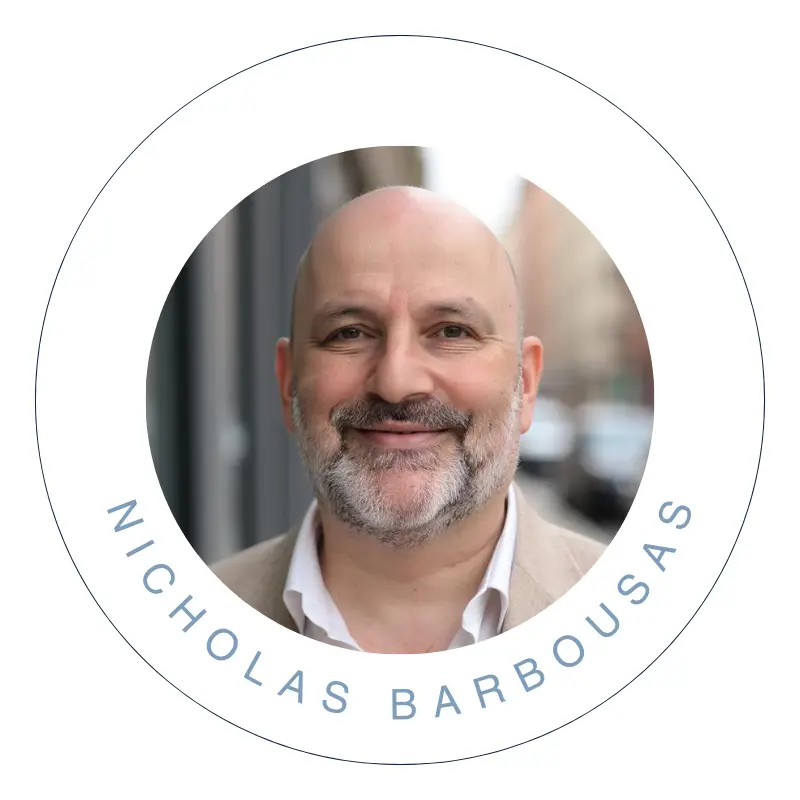
Nicholas Barbousas
Nicholas Barbousas is the founder of PostureGeek and a practitioner who has spent more than 30 years working with posture and movement.
His work draws on structural integration, myofascial approaches, movement education, and long-term clinical observation of posture and movement patterns.
Through PostureGeek he focuses on helping practitioners organise what they observe in practice and develop clearer clinical reasoning when working with posture and movement patterns.
You can learn more about his work at PostureGeek.com.
Ready to bring more clarity into your assessments?
A structured, practical framework you can apply immediately in real sessions.
$127.00
Instant access. Lifetime availablility.
Secure checkout via Stripe