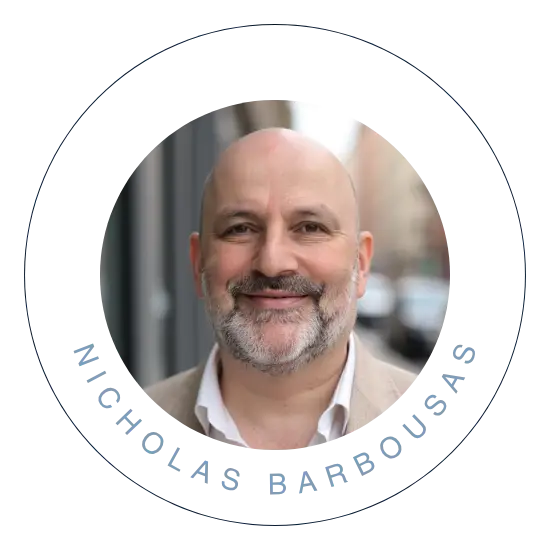
Nicholas Barbousas
Founder of PostureGeek · Structural Assessment Educator · 30+ Years Clinical & Teaching Experience
Nicholas Barbousas is a structural assessment educator with over 30 years of clinical practice and postgraduate teaching experience in movement and manual therapy.
He founded PostureGeek to bridge the gap between what practitioners observe and how they interpret it, and PostureGeek Learning to teach the reasoning system that closes that gap.
30+
Years clinical practice & education
18+
Modalities taught across
WSU
Inaugural MFR program convener
SPR
Methodology creator
In his own words
The profession rarely seemed to matter. In physiotherapy clinics, osteopathy practices, chiropractic rooms, massage studios, Pilates settings, and yoga spaces, the same challenge kept appearing.
Practitioners who knew their anatomy, who had done the advanced training, and who could speak confidently about muscles, movement, and fascial chains, but who still struggled with the most important question when a complex client walked in:
That question sits at the heart of why PostureGeek Learning exists. It was never a lack of information that made complex cases difficult. It was the sheer amount of it. A shifted pelvis, a rotated ribcage, a forward head, a dropped arch. All of it is visible. All of it is relevant. But when everything seems important, it's hard to know what to address first.
What I came to see, across thousands of clinical hours and decades of teaching practitioners from many different modalities, was that the real issue was not knowledge. It was reasoning. The ability to look at a complex presentation and distinguish what is organizing the pattern from what is adapting around it.
To separate the driver from the compensation.
That distinction became the Clinical Triangle, and it became the foundation of everything I teach.
Background
As a practitioner
30+ years clinical practice
Nicholas is a soft tissue therapist with more than 30 years of experience in muscular and movement therapies. His clinical work is rooted in Structural Integration and Myofascial Release, with a deep focus on posture correction and movement education.
His particular expertise lies in understanding the relationship between our physical environments and their impact on structural presentation, and how posture and movement patterns develop, persist, and respond to intervention.
At the heart of Nicholas's clinical philosophy is a simple belief: lasting change requires the capacity to help yourself. His work centers on building that capacity in every client he sees.
As an educator
30+ years clinical practice
Nicholas has taught across a broad range of movement and manual therapy disciplines, working with practitioners from Osteopathy, Physiotherapy, Myofascial Release, Structural Integration, massage therapy, Pilates, personal training, and other posture and movement-based fields.
His teaching has spanned postgraduate workshops, university-based education, private mentoring, and practitioner training developed outside institutional settings. Across these different environments, the focus has remained the same: helping practitioners think more clearly, recognize patterns more accurately, and make better decisions in front of complex clients.
He was also the inaugural convener and co-developer of the Myofascial Release program within the Bachelor’s and Master’s degrees of Osteopathy at Western Sydney University, helping establish fascia-informed clinical education within the curriculum.
Alongside this, Nicholas has developed and led his own professional education programs, contributing to the growth of structural and myofascial thinking across multiple disciplines and training contexts.

ATMS National Fascia Symposium, Sydney, 27 February 2027
From Symptom to System
Structural Pattern Recognition in the Connected Body
Nicholas is presenting at the symposium on how practitioners can move from observing relationships across the body to forming and testing useful clinical hypotheses.
As a contributor
Posturegeek
Continuing this vision, Nicholas created PostureGeek as a platform with two connected purposes: to help the public better understand posture and movement, and to support practitioners in thinking more clearly about what they see in practice.
On the public side, PostureGeek.com provides practical, accessible insight into how posture and movement patterns can influence pain, function, and overall wellbeing.
On the professional side, PostureGeek Learning is where Nicholas teaches Structural Pattern Recognition, a clinical reasoning approach designed to help practitioners identify what is driving a presentation, filter out unnecessary noise, and make better decisions with greater confidence.
Different audiences, same foundation: seeing the body as a system, recognizing what matters most, and responding with clarity.
What i believe
Technique matters, but reasoning is what gives it direction.
Most practitioners already have a strong base of manual skills, exercise knowledge, and assessment tools. What is often missing is a clear way to decide what to use, when to use it, and why.
Confidence should come from understanding, not just outcomes.
A good result matters, but it is not enough on its own. Real clinical confidence comes from being able to explain the logic behind what worked, so that process can be repeated, adapted, and refined with different clients in different contexts.
The body rarely presents in isolated parts.
A shoulder complaint shaped by a thoracic pattern will not always respond to shoulder-focused treatment alone. Structural reasoning helps connect the broader relationships that can underlie a presentation.
The re-check is part of the reasoning process.
Observe, test, intervene, then reassess. If something changes, that tells you something useful. If it does not, that tells you something useful, too. Both help refine the next decision.
Clear thinking can be taught across disciplines.
I have worked with practitioners from physiotherapy, osteopathy, chiropractic, massage therapy, Pilates, personal training, yoga, Feldenkrais, Rolfing Structural Integration, and exercise physiology. The methods differ, but the need for clear reasoning remains the same.
what i built from this
The Clinical Triangle
Two expressions of one reasoning system. The Structural Model tells you what matters most. The Reasoning Loop tells you how to confirm it. One system, applicable across every modality and every client.
Explore the full methodology →
a note to practitioners
I didn't build PostureGeek Learning because the world needed another course platform. I built it because, over many years, I kept meeting practitioners who were capable, knowledgeable, and experienced but had never been given a clear way to organize what they were seeing.
That is what the Clinical Triangle became.
Not a technique. Not a protocol. A way of making sense of what you already know, so you can think more clearly, decide more confidently, and trust the logic behind your work.
If that speaks to something you have been trying to develop in your own practice, then you will understand why I built it.
- Nicholas
speaker & media
Available for podcasts, workshops, and guest sessions
Nicholas brings expertise to podcasts, workshops, guest teaching, and media discussions on clinical reasoning, structural assessment, fascia-informed practice, and the challenges of clear thinking amid clinical complexity. He has also taught hands-on Myofascial Release extensively in professional and educational settings.
topics
The Clinical Triangle: How to identify the driver behind a presentation
Why do more techniques not always lead to better clinical decisions?
Fascia-informed practice and hands-on Myofascial Release
Teaching reasoning across a broad range of practitioner disciplines
Building clinical confidence through re-checking and clearer logic
Ready to learn the system?
Clinical Pattern Recognition Made Simple is your entry point into the Clinical Triangle: the reasoning framework Nicholas teaches.
FREE DOWNLOAD
Clinical Reasoning Starter Guide
The Clinical Triangle model, broken down step by step. One PDF. Immediately applicable.
Free. No spam. Unsubscribe any time.