• PostureGeek Learning

Stop second-guessing where to start
in complex assessments

Learn a repeatable reasoning framework that helps you separate what's driving a pattern from what's compensating for it, so you walk into every session with a clear starting point.

You're not struggling because you lack skill.

You've done the training. You're good with your hands. Your clients get results.

But some sessions still feel uncertain. You notice multiple asymmetries, several possible explanations, compensations layered on compensations. You know something's driving the pattern, but you're not sure what.

So you hedge. You treat a bit of everything. You leave the session feeling like you addressed symptoms but maybe missed the actual driver.

The issue isn't your technique. It's that you don't yet have a consistent reasoning process for deciding what matters most and what to address first.

This is exactly what experienced practitioners describe when they say assessment has become harder over time, not easier. More experience means more information, and without a framework, more information creates more noise.

"The loudest finding in the room is often not the Driver. It's what the body built to protect itself from the Driver."

From Clinical Reasoning in Practice on PostureGeek.com

You don't need another technique.
You need a way to think.

A reliable process for organising what you see, testing what you suspect, and deciding where to begin. That's what this course teaches.

32

Years Clinical Practice

27+

Years Teaching

18+

Modalities Represented

The most relevant and useful course I have ever taken. His deep understanding made it full of practical insights I began applying with clients the next week and still use today.

Osteopath, Acupuncturist & Yoga Practitioner

Immediately applicable to my work teaching clients exercises. A good balance of theory and practical application. Highly recommended.

Exercise Professional

Nicholas's workshop on posture analysis was exceptional. I still use his teachings daily to assess my clients.

Pilates Instructor and Teacher

Clinical Pattern Recognition Made Simple

$77

(Normally $97)

Save $20

Instant access after checkout

5 video lessons + 17 clinical downloads

Lifetime access, no subscription

100% Secure Checkout

What You'll Learn to Use

The course is built around one named reasoning framework with two expressions that work together.

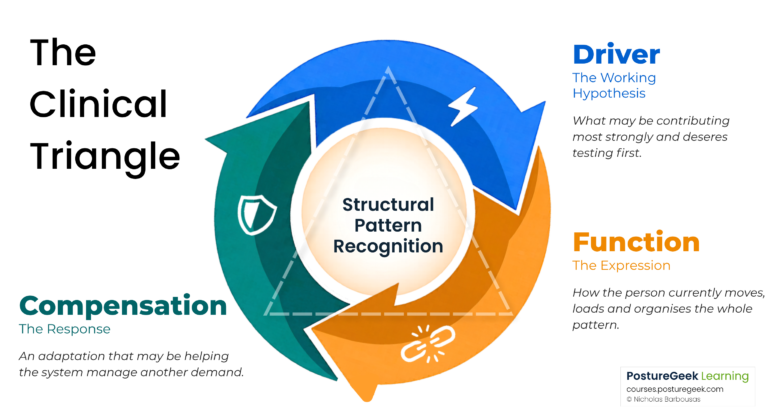
The Clinical Triangle

A structural model for reading any postural or movement presentation. The Driver sits at the apex, organising the whole pattern. Compensations respond to it. Function reflects the system as a whole. This relationship is what you learn to see.

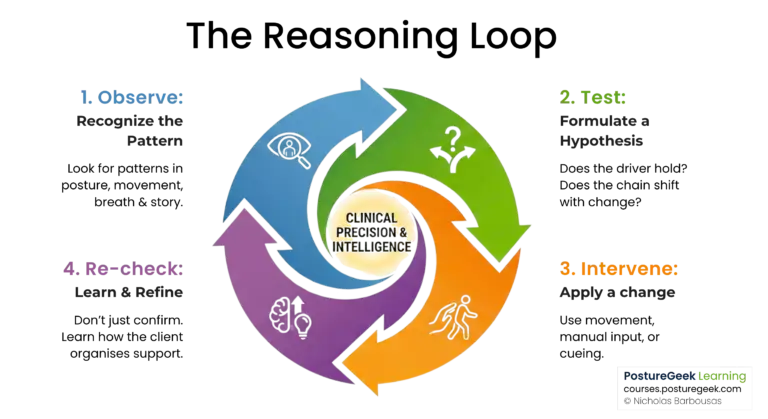
The Reasoning Loop

Before you apply any technique, you should be able to say: "I think the driver is X. If I'm right, this intervention should produce this specific change." Then you verify it. Observe, Test, Intervene, Re-check.
Five Lessons. Three Driver Patterns.

Approximately 100 to 115 minutes total. Self-paced.

Lesson 1
WHY PATTERNS MATTER​

Shift from cataloguing isolated findings to reading the body as an integrated system. Learn the 3-Question Reasoning Loop and the driver vs compensation distinction that runs through every lesson that follows.

Lesson 2:
THE PELVIS AS A PRIMARY DRIVER

Understand how pelvic orientation shapes the whole chain - above and below. Recognise when the pelvis is the driver, identify how it presents, and learn the common traps that cause this pattern to be missed or misread.

Lesson 3:
The Shoulder as a Driver and Compensation

Trace how rib cage orientation sets scapular position, and how neck and shoulder symptoms are often the end of a chain that began lower. Learn to read the rib-scapula relationship before treating the shoulder directly.

Lesson 4:
Pelvic Orientation and Functional Leg Length

Explore how pelvic rotation creates the appearance of a leg-length difference, and why chasing the leg length is a trap. Understand the orientational logic behind the pattern and what a re-check actually confirms.

LESSON 5:
Pulling It Together

Apply the full reasoning process across a mixed-driver case. Use the Clinical Triangle to separate what's driving the pattern from what's compensating for it, and practise making clear decisions about where to begin.

What changes after this course

Before

Noticing multiple issues but unsure which one matters most

Feeling less certain as sessions get more complex

Treating a bit of everything and hoping something sticks

Second-guessing yourself after the client leave

No consistent process for organising what you see

After

Reading the pattern and identifying the most likely driver

Knowing where to begin and why, before you touch the client

More confident in complex sessions, not less

A repeatable reasoning process you can apply immediately

Existing skills applied with clearer direction and purpose

17 Clinical Downloads Included

Designed for use in real sessions, not just study.

5

Quizzes

5

Worksheets

5

Reference Docs

2

Observation Guides

Built for practitioners across modalities

If you assess posture or movement as part of your clinical work, this course applies to you.

Clinical and Allied Health

Physiotherapy / Physical Therapy, Chiropractic, Osteopathy, Exercise Physiology, Podiatry, Occupational Therapy, Athletic Therapy, Acupuncture

Movement, Manual, and Education-Based Disciplines

Rolfing Structural Integration, Massage Therapy, Pilates, Personal Training, Alexander Technique, Feldenkrais Method, Yoga, Strength and Conditioning, Rehab Coaching, Somatic Education

No specific modality background required. The framework is modality-inclusive.

Clinical Pattern Recognition Made Simple

$77

(Normally $97)

Save $20

Instant access after checkout

5 video lessons + 17 clinical downloads

Lifetime access, no subscription

100% Secure Checkout

You might be thinking...

I’ve been practising for years. Will this really tell me something I don’t already know?

Experienced practitioners are exactly who this is for. You already have strong hands and good instincts. What this course adds is a structured way to organise the complexity you’re already seeing, so you can act on it with more confidence and less hesitation.

It’s only $77. Can it really be substantial enough to change how I assess?

This is a focused micro-course, not a weekend workshop padded with filler. Five lessons, three driver patterns, one reasoning framework. The practitioners who’ve studied with Nicholas consistently say that the reasoning approach changes how they assess from the first session they apply it. The price reflects the format, not the depth.

What if it doesn’t work for my modality?

The Clinical Triangle doesn’t replace what you do. It changes how you decide what to do first. Practitioners across physiotherapy, osteopathy, chiropractic, massage, Pilates, exercise physiology, and structural integration have applied this successfully. The framework is modality-inclusive by design.

I don’t have time for another long course.

Total runtime is around 100 minutes. While watching it through once is suggested, practitioners often watch one lesson, apply it with a client or two, then move to the next. You can work through the entire course in a week without clearing your schedule.

Quick Answers

Is it live or self-paced?

Self-paced. Start immediately, revisit anytime.

You’re logged in immediately after checkout and taken straight to your student dashboard.

You’ll also receive an email prompting you to update your temporary account details to your preferred email address.

No formal guarantee is offered. The reasoning framework draws on decades of clinical practice, but some of the concepts have been developed and formalised more recently, and how useful something is depends on how you engage with it and apply it in your own context.

What I can say honestly: if you work with posture and movement, and you apply this to real clients as you go through it, you will likely find something here that changes how you assess. That’s been the consistent feedback from practitioners who have worked through it with me in person.

Yes. One payment, lifetime access, including any future updates to the course content.

Nicholas Barbousas

Nicholas is the founder of PostureGeek Learning and has spent over 32 years working with posture and movement in clinical practice.

For more than 27 years he has developed and delivered education across undergraduate and postgraduate levels, helping practitioners improve how they assess and interpret structural and movement patterns.

Through PostureGeek Learning, he teaches Structural Pattern Recognition: a clinically grounded approach to cutting through complex presentations, identifying primary drivers, and making clear, prioritised treatment decisions.

Your next complex session
doesn't have to feel uncertain.

Learn a reasoning process you can apply immediately.

Clinical Pattern Recognition Made Simple

$77

(Normally $97)

Save $20

Instant access after checkout

5 video lessons + 17 clinical downloads

Lifetime access, no subscription

100% Secure Checkout

Scroll to Top