Speaker & Media
Clinical reasoning is the skill most practitioners were never taught.
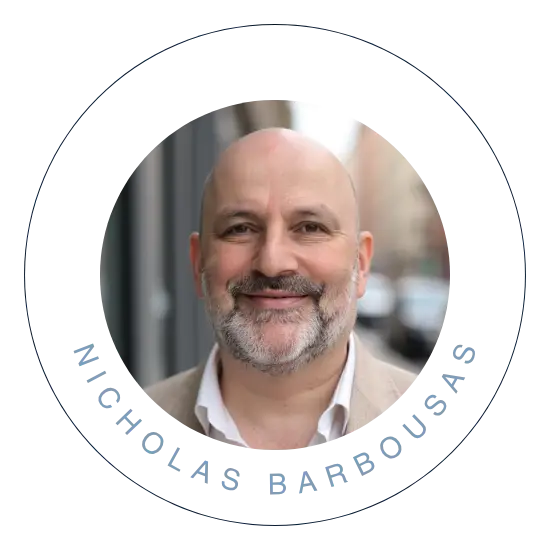
Nicholas Barbousas is a structural assessment educator who teaches Structural Pattern Recognition , a clinically grounded way to identify what is actually driving a complex presentation, separate primary drivers from compensations, and make clear, prioritised treatment decisions. With over 30 years of clinical practice and 27 years of postgraduate teaching, he brings rare depth to the intersection of clinical reasoning and practitioner development.
30+
Years Clinical Practice
27+
Years Teaching
18+
Modalities Served
Signature Topics
What Nicholas talks about
Each topic is grounded in clinical practice and designed to give practitioners something they can apply immediately. All six are available as standalone conversations or as threads within a longer interview.
01
Why More Techniques Rarely Solve Complex Clinical Problems
When a treatment isn't working, the default assumption is that the technique was wrong. But in complex presentations, technique is almost never the issue. The issue is applying the right technique to the wrong problem. This conversation reframes the plateau most experienced practitioners hit, and what it actually takes to move past it.
Clinical Reasoning
02
The Most Expensive Mistake in Structural Assessment: Treating Compensations as Drivers
Most of what the body presents visually is adaptation, not origin. Treating a compensation as if it were the primary driver produces temporary relief at best and patient frustration at worst. This topic walks through how to develop the clinical eye that distinguishes one from the other, and why the distinction changes everything.
Assessment
03
Assessment Is a Decision, Not a Ritual
Many practitioners go through the motions of assessment without the findings actually changing what they do next. Real clinical assessment generates a decision. What to prioritise, what to defer, and what to recheck. This conversation examines the gap between assessment as information gathering and assessment as clinical reasoning.
Clinical Process
04
Posture Assessment: Navigating Complexity Without Being Paralysed By It
Complexity in posture and movement presentations is real. The problem isn't the complexity, it's when complexity becomes a reason to treat everything or nothing. Structural Pattern Recognition provides a navigation system for complex cases, allowing practitioners to move with clarity rather than defaulting to scatter or deferral.
Clinical Reasoning
05
The Reasoning Framework Every Practitioner Needs (Regardless of Modality)
Clinical reasoning is often assumed to be modality-specific. At the structural pattern level, it isn't. The body doesn't reorganise its compensation strategies based on who is treating it. This conversation makes the case for a shared reasoning framework that sits above modality -- and why that benefits every discipline in the room.
Practitioner development
06
What Postgraduate Education Gets Wrong About Clinical Development
The profession has invested heavily in technique and evidence literacy. The gap that remains is clinical decision-making at the complex end. This is a broader conversation about where professional development falls short for experienced practitioners, and what a reasoning-first approach to postgraduate education could look like.
Professional Development
the central argument
This is the position Nicholas returns to regardless of the angle of the conversation. It is the thread that connects every topic he speaks about and the foundation of PostureGeek Learning's clinical curriculum.
Audience fit
Who this is for
Nicholas's content is relevant to practitioners at every stage of clinical development. The reasoning framework he teaches lands differently depending on experience. It is useful from the beginning of a career, not only after hitting a ceiling.
Relevant to audiences in
Clinical and Allied Health
Physiotherapy / Physical Therapy, Chiropractic, Osteopathy, Exercise Physiology, Podiatry, Occupational Therapy, Athletic Therapy, Acupuncture
Movement, Manual, and Education-Based Disciplines
Rolfing Structural Integration, Massage Therapy, Pilates, Personal Training, Alexander Technique, Feldenkrais Method, Yoga, Strength and Conditioning, Rehab Coaching, Somatic Education
Show fit indicator
If your audience treats bodies that don't respond predictably --- complex, persistent, or multi-site presentations --- this conversation will be directly relevant to their clinical practice.
interview format
How Nicholas works best
Nicholas is equally comfortable in long-form conversations and focused short-form interviews. The content is deep enough to sustain an extended dialogue and concrete enough for a tightly structured episode.
Long-form (60-90 min)
Best suited to deep-dive clinical reasoning conversations. The full range of talking points can be explored with clinical examples and case narratives. Recommended for shows with experienced practitioner audiences.
Focused (30-45 min)
A single topic explored in practical depth. Works well as a standalone clinical reasoning episode. Nicholas can anchor an entire shorter appearance in one signature talking point and keep it concrete throughout.
Panel or roundtable
Nicholas holds a clear and distinctive position that contributes well to multi-guest formats, particularly panels on clinical education, postgraduate development, or interdisciplinary practice.
Remote (video or audio)
Based in Australia. Available for remote recording via the host's preferred platform. Audio setup is podcast-grade. Flexible on scheduling across time zones with advance notice.
Biography
About Nicholas Barbousas
Nicholas Barbousas is a structural assessment educator with over 30 years of clinical practice and 27 years of postgraduate teaching experience. Through PostureGeek Learning, he teaches Structural Pattern Recognition, a clinically grounded approach to cutting through complex presentations, identifying primary drivers, and making clear, prioritised treatment decisions.
Originally trained in Rolfing Structural Integration, Nicholas developed a rigorous clinical eye for structural pattern analysis over decades of practice. Over time his focus shifted from individual clinical work to the reasoning system beneath it: how a practitioner thinks, decides, and sequences care, regardless of their modality.
His teaching is modality-inclusive by design. The practitioners he works with come from physiotherapy, chiropractic, osteopathy, Rolfing, massage therapy, Pilates, exercise physiology, podiatry, acupuncture, personal training, the Alexander Technique, Feldenkrais, and yoga. What they share is not a technique. It is a clinical problem: how to navigate complex presentations with clarity and confidence.
PostureGeek Learning was built to formalise that answer.
At a glance
Interested in having Nicholas on your show?
If your audience includes practitioners working with postural, movement, or pain presentations, Nicholas would love to be part of the conversation. Get in touch with your show name, typical episode length, and a brief description of your audience.
Please include your show name, typical episode length, and a brief description of your audience. A response can be expected within 5 business days.